Ticketing Trouble
When a routine airport check-in experience gives way to fear and anxiety and insights about improvement.

“You have a booking, but not a ticket,” the woman said, as she handed back my passport and iPhone, shaking her head. “I can’t check you into this flight.”
At the end of a long week being on the road for work, sleeping in a badly-lit hotel rooms, eating ballroom chicken lunches, this is just about the last thing I wanted to hear.
But there I was, at the check-in desk for my 10:30pm Sunday night flight home.
Yes, I was 3 hours in advance.
Yes, I had my bags packed and under-weight.
Yes, I have TSA Pre-Check and GlobalEntry and Clear and RealID, having given the government everything but my first-born child to zoom through security lines just a bit faster.
I have AirTags in every bag, suitcase, carry-on I own. I have opinions about the seat configuration on the Airbus versus the Boeings.
I’m a seasoned air traveler—being a consultant over the years does that to you. I have every major airline’s app downloaded to my phone and FlightAware tracking my incoming aircrafts, always looking out for a delay or cancellation before its even announced. I have Diamond Platinum Medallion status (that’s the top 1% of our customers! the email proudly announced).
And yet here I was, unable to check in.
My stomach dropped and I felt my pulse quicken. I knew I had changed this flight—moved the return date to accommodate a schedule change. Had I really forgotten to re-book the flight? I had a young puppy at home, already having exhausted 7 days of puppy-sitting favors from friends. I had visitors arriving soon, laundry to do, and a full week of meetings that were going to start in 12 hours.
I felt awful. Panicked. Confused. Stressed. Stupid.
Signals: Positive, Positive, Positive, Negative
My brain was working in overdrive—pulling from memory the fact that I remember making the flight change and receiving email confirmation.
Signal: The flight had automatically pre-populated onto my calendar from the confirmation email from the airline.
Signal: The automatic “Check in now ” email had arrived 12 hours before, and I had dutifully checked in.
Signal: The app on my phone showed my seat number, the boarding gate, and my confirmation number.
All these signals were indicating to me that I had a seat on this plane. And yet; it was not so.
I thought about this moment within the context of improvement work (later, after a drink in the lounge); how often do we give users of a particular system or process mixed signals, little crumbs along the way that would imply the user is on the right track, when in fact they are not?
Some work I’m currently engaged in right now has to do with improving the transition of college students from 2-year institutions (community colleges) to 4-year institutions. 2yr- and 4yr-institutions are set up very differently and have different processes. So when a student has spent 24 months learning one system, they tend to assume it’ll be the same elsewhere, and this can lead to pretty bad outcomes.
As an example: most 2-year institutions do not have mandatory advising prior to enrolling in courses for the semester; you simply wait for course registration to open and you self-register. At 4-year institutions, as students transfer in as upperclassmen, there are requirements that a faculty advisor meets with and creates the students’ schedule. It’s a fairly straightforward process…if you know it exists. If you don’t, you simply think you’re waiting around for course registration to open up. You’re still receiving welcome emails, details about housing, maybe even tickets to the homecoming game. Positive, positive, positive signals.
Suddenly, the negative signal hits: you’re locked out of upper division courses because they’re already full once self-registration opens.
One team I was working with sought to change this. They reached out to students proactively during the summer before the fall semester and proactively provided the advising. 55% of the students they reached were indeed not registered for courses; they were waiting for the institution to signal to them. 81% of the students they served in this alternative process successfully registered for fall courses and the institution saw a 57% increase in transfer student enrollment in 12 months.
What You Say to End Users vs. What You Say to Practitioners
“You have a booking, but not a ticket,” the woman said.
It felt like the single-most frustrating thing I’d ever heard in my life; because I didn’t understand what she meant.
I kept repeating it back to her “I have a booking…but not a ticket??” She finally tired of me, sighed, and told me to go talk to another desk, over there, pointing into oblivion.
I huffed over and explained my situation to the man behind the new counter. He tipped and tapped his machine and furrowed his brows. He finally smiled and said “I see what happened here—you booked this ticket through us, but it’s our sister company’s flight. Somewhere in the back end, the computer didn’t assign you a ticket on the sister flight, but don’t worry, you have a seat on this plane. We just need to fix the back end and you’ll be all set to go.”
I felt like I nearly might have kissed the man. With one small explanation, he washed away my anxiety and fear that the outcome was bad. It wasn’t; it was just a back-end error that needed to be corrected.
The woman at the check in desk wasn’t wrong; I indeed did not have a ticket. But she didn’t realize that saying “you don’t have a ticket” is not the kind of thing people want to hear as they roll into an airport. She didn’t adjust her communication about the problem for the person she was speaking to. I’m sure to many folks who work in the airline industry, the phrase “you have a booking, but not a ticket” makes perfect sense and would elicit no stress at all; but airline customers tend not to work in airlines.
My point is— you can be right about your description of a problem, but terribly wrong in your delivery. How many times do we speak “practitioner” to end users and assume they understand us? How can we do better to align communication for users?
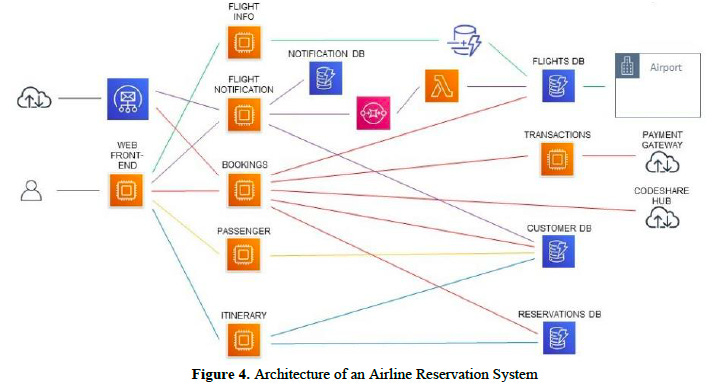
[yes, I went down a wormhole and read some academic articles about the architecture of airline reservation systems, but check out this map and how many databases are used!]
The Airline Industry Continues to Fascinate Me, No Matter This Hiccup
Those who have worked with me in improvement work know that I am endlessly fascinated by the high level of reliability of the airline industry, and that won’t change. But I also love seeing where the cracks are and how we can use these moments and experiences to better our own improvement work.
On A Personal Note…
The intensity of emotions I felt in the heat of the exchange actually surprised me. I am normally a pretty level-headed, cool-calm-collected type person. Even in airports and even in stressful airport situations. But this experience really defied that.
It made me think about this passage from David Foster Wallace’s commencement speech “This Is Water,” about how choosing how to think really is the job of a lifetime.
But anyway, you finally get to the checkout line’s front, and you pay for your food, and you get told to “Have a nice day” in a voice that is the absolute voice of death. Then you have to take your creepy, flimsy, plastic bags of groceries in your cart with the one crazy wheel that pulls maddeningly to the left, all the way out through the crowded, bumpy, littery parking lot, and then you have to drive all the way home through slow, heavy, SUV-intensive, rush-hour traffic, et cetera et cetera. […]
The point is that petty, frustrating crap like this is exactly where the work of choosing is gonna come in. Because the traffic jams and crowded aisles and long checkout lines give me time to think, and if I don’t make a conscious decision about how to think and what to pay attention to, I’m gonna be pissed and miserable every time I have to shop. Because my natural default setting is the certainty that situations like this are really all about me. About MY hungriness and MY fatigue and MY desire to just get home, and it’s going to seem for all the world like everybody else is just in my way. And who are all these people in my way? And look at how repulsive most of them are, and how stupid and cow-like and dead-eyed and nonhuman they seem in the checkout line, or at how annoying and rude it is that people are talking loudly on cell phones in the middle of the line. And look at how deeply and personally unfair this is.
I think that part of what draws me to improvement work is this ability to choose—over and over again—to work on improving these systems that frustrate us instead of being so totally sure that its all so deeply and personally unfair.